











We get it, got to test the 'waters'.
Grab a sample pack - usually $24.99
Just $22.49

Walk into any convenience store or gym, and you’ll see the same names everywhere — Red Bull, Monster, Celsius, and dozens of others competing for attention. The category has exploded, and on the surface, that looks like a win for consumers.
But behind the flashy cans and bold claims, the energy drink industry still relies on outdated shortcuts — shortcuts that leave people overstimulated, unfocused, or crashing hours later.
At Underdog, we didn’t set out to copy the market leaders. We built our drink by first identifying what the industry gets wrong — and then fixing it.
Industry Issue #1: Energy That Spikes Instead of Sustains
Most energy drinks — even popular “fitness-forward” options like Celsius — rely on a single caffeine delivery system. The result is familiar:
-
a fast surge of energy
-
heightened alertness
- followed by jitters, anxiety, or a crash
This approach prioritizes feeling something immediately over actually supporting performance across a full workout, workday, or study session.
How Underdog Fixes It
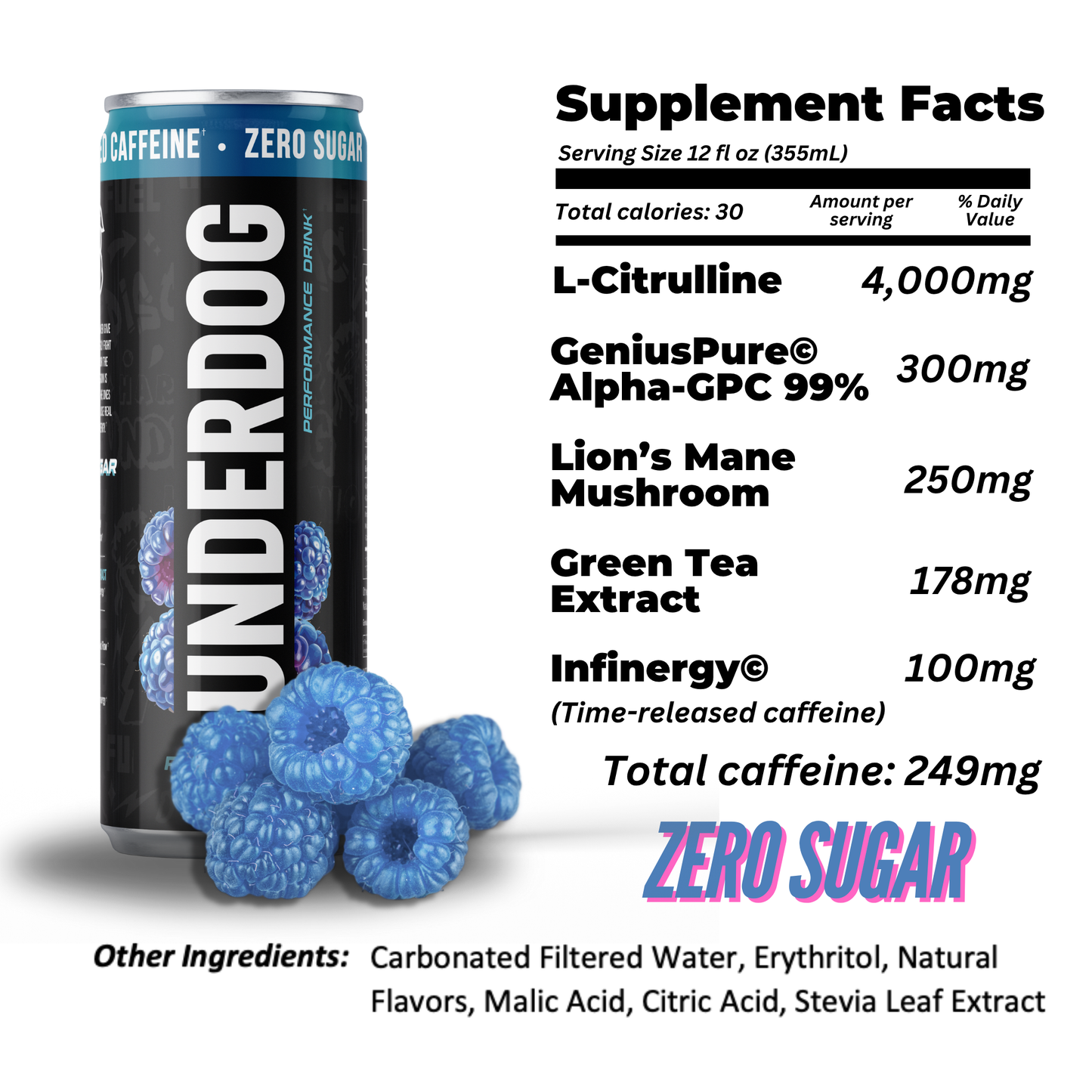
Underdog uses a dual-source caffeine system, combining fast-acting caffeine from green tea with a slower-releasing source. The goal isn’t a spike — it’s smooth, extended energy that works with your body instead of shocking it.
Industry Issue #2: Energy Without Focus or Performance Support
The majority of energy drinks stop at stimulation. Caffeine, taurine, B-vitamins — and that’s it. While that can increase alertness, it doesn’t necessarily improve:
-
focus
-
reaction time
-
endurance
- mental clarity
That’s a problem when energy drinks are being consumed by students, athletes, and professionals who need precision, not chaos.
How Underdog Fixes It
Underdog goes beyond caffeine by incorporating performance-driven ingredients designed to support both body and brain. This includes cognitive support ingredients, like Lion’s Mane Mushroom and Alpha-GPC, that help maintain clarity and physical components, like Citrulline, that support endurance — not just “feeling awake.”
Industry Issue #3: Sugar-Free Isn’t the Same as Clean
Many modern energy drinks promote themselves as zero sugar or low calorie. While that’s a step in the right direction, it often comes with trade-offs:
-
artificial sweeteners
-
heavy flavor masking
- formulas optimized for taste over how they make you feel
“Sugar-free” has become a marketing checkbox — not a guarantee of quality.
How Underdog Fixes It
Underdog focuses on clean formulation, using natural sweeteners and avoiding unnecessary additives. Every ingredient is included for a reason — performance, feel, and transparency — not just label appeal.
Industry Issue #4: Little Transparency, Little Accountability
Despite how widely energy drinks are consumed, third-party testing and certification are rare across the category. Many brands ask consumers to trust proprietary blends and vague claims without offering real verification.
For anyone who cares about what they put in their body — especially athletes — that’s a problem.
How Underdog Fixes It
Underdog is Informed Sport Certified, meaning every batch is tested against hundreds of banned substances. It’s a level of accountability that should be standard — but isn’t.
Industry Issue #5: Marketing First, Performance Second
The energy drink industry has mastered branding. What it hasn’t mastered is engineering energy that actually supports performance over time. Too often, product development is driven by:
-
what looks good on a shelf
-
what trends on social media
-
what delivers the strongest immediate sensation
Long-term usability gets left behind.
How Underdog Fixes It
Underdog is built for people who do, not just people who scroll. Every decision — from caffeine delivery to ingredient selection — is made with real-world performance in mind.
The Takeaway
Red Bull, Monster, and Celsius helped define the energy drink category. But the category itself hasn’t evolved as much as it should have.
Underdog exists because energy shouldn’t come with a crash, confusion, or compromise. It should support focus, endurance, and clarity — consistently. We didn’t build Underdog to be louder than everyone else. We built it to be smarter.
References
Harvard T.H. Chan School of Public Health. Energy Drinks. https://www.hsph.harvard.edu/nutritionsource/energy-drinks/
Mayo Clinic. Caffeine: How much is too much? https://www.mayoclinic.org/healthy-lifestyle/nutrition-and-healthy-eating/in-depth/caffeine/art-20049372
National Center for Biotechnology Information. Effects of energy drinks on the cardiovascular system. https://www.ncbi.nlm.nih.gov/pmc/articles/PMC4682602/
Journal of the International Society of Sports Nutrition. International society of sports nutrition position stand: energy drinks. https://jissn.biomedcentral.com/articles/10.1186/s12970-019-0304-9
Cleveland Clinic. Artificial Sweeteners: Are They Bad for You? https://health.clevelandclinic.org/artificial-sweeteners/
U.S. Food & Drug Administration. Spilling the Beans: How Much Caffeine is Too Much? https://www.fda.gov/consumers/consumer-updates/spilling-beans-how-much-caffeine-too-much
Informed Sport. What Is Informed Sport Certification? https://www.informed-sport.com/about-informed-sport/
Frontiers in Nutrition. Caffeine metabolism and individual variability. https://www.frontiersin.org/articles/10.3389/fnut.2018.00030/full