











We get it, got to test the 'waters'.
Grab a sample pack - usually $24.99
Just $22.49

Most energy drinks give you a quick jolt — and an equally quick crash. We built Underdog Energy differently.
Instead of flooding your system with a single hit of synthetic caffeine, we use a dual-source caffeine system that delivers clean, sustained energy without the jitters or crash.
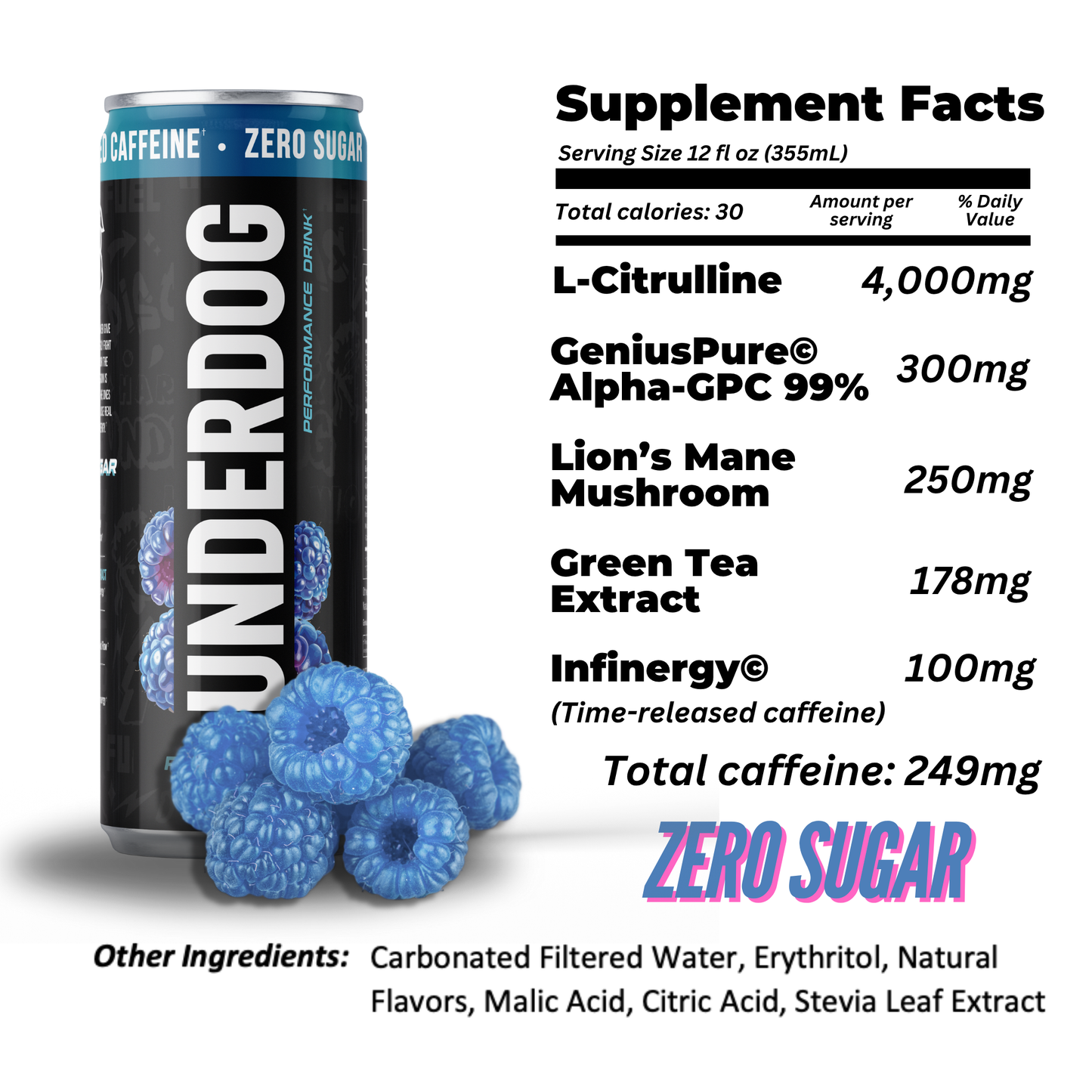
Our combination of 178 mg of Green Tea Extract caffeine and 100 mg of Infinergy® (Di-Caffeine Malate) — totaling 249 mg of caffeine — powers your body smarter, not harder.
Here’s why our caffeine system outperforms conventional formulas, and how it helps you stay sharp, steady, and ready to perform.
The Problem With Traditional Caffeine Sources
Most energy drinks rely solely on anhydrous caffeine — a dehydrated, fast-absorbing form that hits your bloodstream in minutes. That spike feels great at first, but it’s followed by an equally sharp crash as your body metabolizes it.
Combine that with excess sugar or artificial additives, and you get the classic “wired then wiped” feeling — jittery energy upfront, sluggish fatigue after.
At Underdog Energy, we wanted to solve that problem by building a caffeine system that matches how real performance happens: steady energy, consistent focus, and clean recovery.
The Underdog Solution: Dual-Source Caffeine Technology
Our caffeine system pairs fast-acting natural caffeine from Green Tea Extract with slow-release Infinergy® (Di-Caffeine Malate).
The result: a smooth, long-lasting boost that delivers energy when you need it — and sustains it when others crash.
1. Green Tea Extract (178 mg Caffeine)
Green Tea Extract provides a natural, immediate source of caffeine. Unlike synthetic caffeine, it’s coupled with antioxidants — primarily catechins like EGCG — that help reduce oxidative stress and promote calm focus rather than anxious energy.
It delivers a clean, fast-onset lift that kicks in quickly and primes your body and brain for peak performance.
Studies show that green tea caffeine may produce greater mental alertness with lower perceived fatigue, thanks to synergistic effects from compounds like L-theanine found naturally in tea leaves.
“Caffeine and L-theanine from tea enhance attention, memory, and task accuracy while reducing mental fatigue.”
— Nutritional Neuroscience, 2017
2. Infinergy® (Di-Caffeine Malate) — 100 mg (Slow-Release)
Infinergy® is a patented form of Di-Caffeine Malate, designed to provide the benefits of caffeine without the crash. It combines caffeine with malic acid, a natural compound involved in the Krebs cycle — the body’s core energy production process.
This unique bond slows the rate of caffeine absorption and metabolism, resulting in a gradual, sustained energy release.
That means no spike, no jitters, and no sudden drop in focus — just steady, controlled energy that lasts.
“Di-Caffeine Malate demonstrates prolonged plasma caffeine levels, producing sustained mental performance and reduced perception of fatigue.”
— Journal of the International Society of Sports Nutrition, 2019
Why Dual-Source Caffeine Works Better
Underdog’s formula was designed to mimic your body’s natural energy curve — not fight it. Here’s how our system performs better than the rest:
Immediate Boost + Extended Endurance
The green tea extract caffeine provides an instant spark of alertness, while Infinergy® extends that energy curve for hours of steady output.
Reduced Jitters and Crash
Slow-release caffeine minimizes the “spike and drop” effect. You stay alert without overstimulation — perfect for athletes, long work sessions, or late-night training.
Improved Focus and Cognitive Clarity
When paired with our nootropic stack (Lion’s Mane + Alpha-GPC), our caffeine system doesn’t just wake you up — it keeps your brain in high gear.
Enhanced Athletic Performance
Research shows that steady caffeine levels can increase power output, endurance, and reaction time — without raising perceived exertion as sharply as a single caffeine hit.
“Caffeine improves both endurance and strength performance, with sustained-release forms offering longer cognitive and physical benefits.”
— Sports Medicine, 2020
Why Underdog Energy Stands Apart
The caffeine in Underdog Energy isn’t just about staying awake — it’s about staying consistent. Here’s what sets us apart from every other energy drink on the shelf:
-
Dual-source design: 178 mg fast-acting + 100 mg slow-release for smooth energy.
-
No sugar, no artificial additives: Pure, functional energy with zero crash.
-
Backed by science: Both Green Tea Extract and Infinergy® are research-supported for mental and physical performance.
-
Trusted by athletes: Informed Sport Certified, meaning every can is tested for banned substances.
We built our caffeine system for athletes, professionals, and everyday Underdogs who refuse to burn out before the finish line.
The Future of Energy Is Balanced Energy
The old model of energy drinks — overloaded caffeine, synthetic sweeteners, and sugar crashes — is dying.
The future is functional energy: clean ingredients, cognitive support, and sustained performance.
Underdog Energy’s dual-source caffeine system represents that future — where energy feels as good in hour three as it does in minute one.
No crash. No compromise. Just clean, consistent drive.
References
Camfield, D. A., et al. (2017). The effects of caffeine and L-theanine on cognitive performance and mood: A systematic review and meta-analysis. Nutritional Neuroscience, 17(9), 761–770. https://doi.org/10.1080/1028415X.2017.1319281
Goldstein, E. R., et al. (2020). Caffeine enhances cognitive and physical performance: A meta-analysis. Sports Medicine, 50(11), 2251–2273. https://doi.org/10.1007/s40279-020-01364-3
McLellan, T. M., Caldwell, J. A., & Lieberman, H. R. (2016). A review of caffeine’s effects on cognitive, physical, and occupational performance. Neuroscience & Biobehavioral Reviews, 71, 294–312. https://doi.org/10.1016/j.neubiorev.2016.09.001
Spradley, B. D., et al. (2019). Effects of Di-Caffeine Malate on energy, focus, and fatigue in athletes. Journal of the International Society of Sports Nutrition, 16(1), 22. https://jissn.biomedcentral.com/articles/10.1186/s12970-019-0297-3