











We get it, got to test the 'waters'.
Grab a sample pack - usually $24.99
Just $22.49

Most energy drinks look different on the front — but nearly identical on the back.
Caffeine. Taurine. B-vitamins. Sweeteners. A few buzzword additives. The same ingredients appear again and again, yet the experience varies wildly from brand to brand.
The difference isn’t marketing. It’s formulation.
Here’s how to read the most common ingredients on an energy drink label, what they actually do in your body, and why Underdog’s approach stands apart from the rest of the industry.
1. Caffeine: Source, Delivery, and the Energy Curve
What the science says
Caffeine works by blocking adenosine receptors, reducing the perception of fatigue. It does not create energy — it masks tiredness. How caffeine feels depends on:
- absorption rate
- peak plasma concentration
- how quickly it’s cleared
Fast absorption leads to higher peaks, stronger stimulation, and a greater likelihood of jitters and crashes.
Industry standard
Most energy drinks use a single, fast-absorbing caffeine source (often caffeine anhydrous). The goal is immediate impact — not sustained performance.
How to read the label
- Total caffeine ≠ how it will feel
- Look for multiple sources or plant-based caffeine
-
Beware of hidden caffeine from guarana or yerba mate
Why Underdog is different
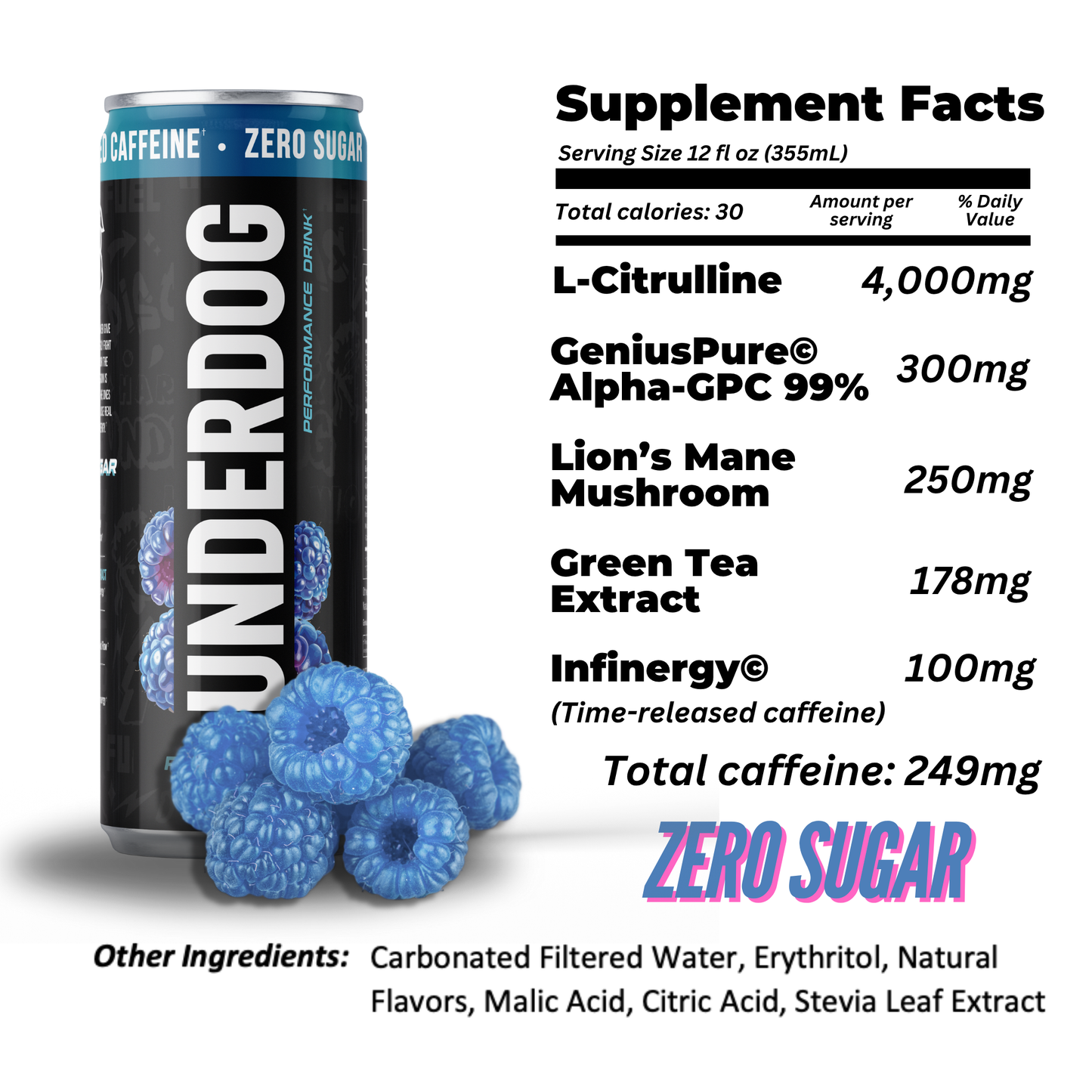
Underdog uses a dual-source caffeine system, combining fast-acting green tea caffeine with a slower-releasing source. This flattens the caffeine curve, delivering smoother, longer-lasting energy without overwhelming the nervous system.
2. Taurine: A Legacy Ingredient with Limited Impact
What the science says
Taurine is an amino acid involved in:
- cellular hydration
- electrolyte balance
-
neuromodulation
It is not a stimulant and does not directly increase energy. In some cases, taurine may actually dampen overstimulation from caffeine.
Industry standard
Taurine is included largely for historical reasons. Many brands include it at low or symbolic doses because consumers expect to see it.
How to read the label
- Taurine presence alone doesn’t indicate performance benefit
-
Dosage matters, but it’s rarely disclosed meaningfully
Why Underdog is different
Underdog doesn’t rely on legacy ingredients for label appeal. Instead of filling space with tradition, the formula prioritizes ingredients with clearer performance pathways.
3. B-Vitamins: Metabolism Support, Not Instant Energy
What the science says
B-vitamins act as coenzymes in energy metabolism. They help convert nutrients into ATP, but they do not produce immediate energy unless a deficiency exists.
Excess B-vitamins are water-soluble and typically excreted.
Industry standard
Many energy drinks include B-vitamins at extremely high percentages of daily value to imply strength — despite no added benefit.
How to read the label
- High %DV does not equal stronger energy
-
B-vitamins support long-term metabolism, not acute stimulation
Why Underdog is different
Underdog includes ingredients that influence how energy feels and functions, rather than inflating vitamin numbers for marketing impact.
4. Sweeteners: Metabolic and Neurological Effects
What the science says
Artificial sweeteners can interact with:
- gut microbiota
- insulin signaling
-
dopamine and reward pathways
They don’t add calories, but they are not inert.
Industry standard
Most sugar-free energy drinks rely on artificial sweeteners and heavy flavor masking to offset harsh stimulant profiles.
How to read the label
- Look for sucralose, acesulfame potassium, aspartame
-
Fewer additives usually signal a cleaner formula
Why Underdog is different
Underdog uses natural sweeteners and avoids unnecessary additives. The formula is designed to taste clean because it’s built clean — not because flavors are masking overstimulation.
5. “Extra” Ingredients: Hype vs. Function
What the science says
Ingredients like citrulline, Alpha-GPC, and Lion’s Mane support:
- blood flow and endurance
- acetylcholine production
-
neuronal health
These compounds affect performance systems, not just stimulation.
Industry standard
Many brands include these ingredients at trace or ineffective doses to justify performance claims.
How to read the label
- Ask whether the ingredient meaningfully affects physiology
-
Transparency matters more than length of list
Why Underdog is different
Underdog includes performance-supporting ingredients at functional levels and fully discloses dosages. No proprietary blends. No filler.
The Takeaway
Most energy drinks are engineered to feel intense — briefly.
Underdog is engineered to feel effective — consistently.
When you understand how caffeine delivery, ingredient function, and formulation strategy work together, reading an energy drink label becomes simple. The brands built on marketing shortcuts reveal themselves quickly.
Underdog exists because energy shouldn’t spike, confuse, or crash. It should support how people actually perform — day after day.
References
Harvard T.H. Chan School of Public Health. Energy Drinks https://www.hsph.harvard.edu/nutritionsource/energy-drinks/
Journal of the International Society of Sports Nutrition. International Society of Sports Nutrition Position Stand: Energy Drinks
https://jissn.biomedcentral.com/articles/10.1186/s12970-019-0304-9
National Center for Biotechnology Information (NCBI). Effects of Energy Drinks on the Cardiovascular System
https://www.ncbi.nlm.nih.gov/pmc/articles/PMC4682602/
NCBI. Taurine and Its Physiological Roles
https://www.ncbi.nlm.nih.gov/pmc/articles/PMC5452224/
NCBI. B Vitamins and Energy Metabolism
https://www.ncbi.nlm.nih.gov/books/NBK470579/
NCBI. L-Citrulline Supplementation and Exercise Performance
https://www.ncbi.nlm.nih.gov/pmc/articles/PMC6073798/
NCBI. Alpha-GPC and Cognitive Function
https://www.ncbi.nlm.nih.gov/pmc/articles/PMC4595381/
NCBI. Neuroprotective Effects of Hericium erinaceus (Lion’s Mane Mushroom)
https://www.ncbi.nlm.nih.gov/pmc/articles/PMC5987239/
Cleveland Clinic. Artificial Sweeteners: Are They Bad for You?
https://health.clevelandclinic.org/artificial-sweeteners/
Informed Sport. What Is Informed Sport Certification?